Basements bring their own set of headaches: moisture that creeps in through the slab, ceilings too low for a standard light fixture, and wiring nobody wants to touch. Those same challenges explain why well-planned basement laundry millwork looks so dramatic in before-and-after photos.
The EPA recommends drying out any water-damaged materials within 24 to 48 hours to head off mold growth, a detail that matters a lot once you're staring at a damp basement floor.
This guide walks through planning, the step-by-step transformation process, what's trending in 2026, and what it actually costs, so you can move forward with a plan instead of guesswork.
Key Takeaways
- Fix moisture and ventilation problems before touching drywall, flooring, or cabinetry
- Simple refreshes start around $1,800; full transformations with plumbing can reach $42,000
- Porcelain tile and vinyl plank top the list for basement-ready flooring
- Custom cabinetry works around low ceilings and exposed pipes that stock cabinets can't
- 2026 trends favor personality-driven color and natural materials over cold, utilitarian basics
Common Basement Laundry Room Problems: The "Before"
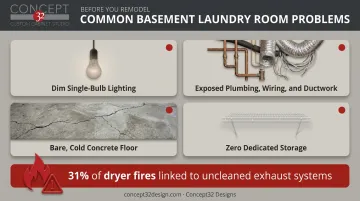
Walk into most unfinished basement laundry rooms and you'll find the same setup: a single bare bulb, a concrete floor that's always a little too cold, and pipes overhead nobody bothered to box in.
Typical "before" conditions include:
- Dim, single-source lighting that makes sorting darks from lights a guessing game
- Exposed plumbing, wiring, or ductwork with no clean way to conceal it
- Bare concrete floors that stay cold and show every crack
- Zero dedicated storage for detergent, dryer sheets, or folded clothes
Moisture is the bigger issue hiding underneath the cosmetic problems. Basements sit below grade, so groundwater, condensation, and poor drainage tend to show up here before anywhere else in the house. Left unaddressed, that dampness turns into mold, mildew, and the musty smell that never quite goes away.
Ventilation issues compound this. An improperly vented dryer doesn't just waste energy; it's a fire risk. Failure to clean the exhaust system was the leading ignition factor in 31% of home clothes-dryer fires reported between 2018 and 2020, according to the U.S. Fire Administration.
In older basement setups, vent runs are often too long, crushed, or terminating indoors instead of outside. That single oversight can turn a simple duct fix into a full dryer replacement or worse.
Planning Your Basement Laundry Room Millwork
Setting a Budget and Scope
Before picking a paint color, decide what kind of project you're actually doing.
- Cosmetic refresh: New paint, better lighting, some shelving. Days, not weeks.
- Partial upgrade: Added storage, new flooring, and updated lighting fixtures without moving major plumbing lines. A week or two, with minimal permitting required.
- Full transformation: Moved plumbing, new flooring, custom cabinetry, possibly waterproofing. Weeks to months, with permits likely involved.
These paths land in very different budget territories, covered in detail below. Knowing which one you're signing up for now saves you from mid-project scope creep, unexpected costs, and design decisions you'll regret later.
Assessing Layout and Functionality
Grab a tape measure before you grab a paint swatch.
Map out where your water lines, drains, and dryer connections (gas or electric) actually sit. Basements often have utilities in inconvenient spots, like a drain in the middle of the floor or a vent stack exactly where you wanted a folding counter.
Once you know what you're working with, list your daily frustrations:
- Not enough space to fold laundry
- Nowhere to stash detergent, stain remover, or dryer sheets
- Bad lighting over the sink or work surface
- Baskets and hampers cluttering the floor
That list becomes your priority order for upgrades. This is also a good point to bring in a professional. Concept32 Designs offers a free in-home consultation. A designer measures the space, discusses storage needs, and maps out a layout that works around your basement's existing quirks before you commit to a single material.
Before & After Transformation Guide: Step-by-Step
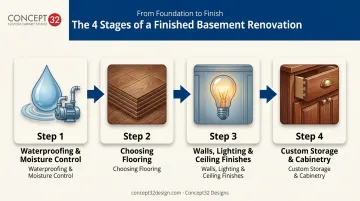
Every strong basement laundry transformation follows the same order, whether it's a Longmont ranch home or a Fort Collins split-level. Skip a step, and it tends to come back later.
Step 1: Waterproofing and Moisture Control
Handle water before anything else touches the room. Drywall, flooring, and cabinetry installed over an unresolved leak just hides the problem, and mold doesn't wait for a convenient time to show up.
Common fixes homeowners research first:
- French drains to redirect groundwater away from the slab
- Sump pumps to remove water that does get in
- Dehumidifiers to manage airborne moisture once bulk water is under control
A dehumidifier controls humidity in the air. It won't fix a leaking foundation, so address the source first.
Step 2: Choosing the Right Flooring
Once the slab is dry and stable, pick a floor built for basement conditions.
| Flooring | Why It Works Below Grade |
|---|---|
| Porcelain tile | Extremely low water absorption; wipes clean easily |
| Vinyl plank | Water-resistant surface, comfortable underfoot, budget-friendly |
| Epoxy-coated concrete | Seals the existing slab, low-maintenance |
Porcelain tends to be the favorite for basement laundry rooms since it's waterproof, durable, and simple to clean after a detergent spill. Whatever you pick, repair and level the concrete first. New flooring over an uneven or damp slab won't perform the way the manufacturer promises.
Step 3: Walls, Lighting, and Ceiling Finishes
With the flooring settled, the room's biggest remaining weakness is light. Basements are naturally dim, so this step fights that head-on.
- Choose bright, reflective paint colors instead of dark, moody tones
- Consider moisture-resistant wall treatments like beadboard near the sink
- Layer lighting: overhead fixtures for general brightness, plus task lighting over the folding counter and sink
A basement laundry room with flat, single-bulb lighting will always feel like an afterthought, no matter how nice the cabinets are. Layered lighting is often the cheapest upgrade with the biggest visual payoff.
Step 4: Custom Storage and Cabinetry
This is where a basement laundry room stops feeling like a utility closet.
Built-in cabinetry, a folding counter, and hanging rods solve the three problems nearly every basement laundry room has: nowhere to fold, nowhere to hang, nowhere to store supplies.
Custom cabinetry offers one more advantage down here: it can be built around low ceilings, exposed pipes, and other obstacles that stock cabinets aren't designed to handle.
Concept32 Designs manufactures cabinetry locally in Longmont. Each piece, including pull-out hampers, built-in drying racks, and countertop workspaces, is built to the exact dimensions of your basement, obstacles included, rather than forced into a standard size.
2026 Basement Laundry Room Design Trends
Basement laundry rooms are finally getting the design attention once reserved for kitchens and bathrooms.
- Personality over utility: Bold wallpaper, patterned tile, and deep color drenching are replacing all-white, all-beige basics
- Multi-functional storage: Slide-out ironing boards, labeled bins, and hidden hampers keep supplies organized without cluttering the counter
- Warm, natural materials: Wood countertops and lighter wood cabinetry are replacing the cold, purely utilitarian basement look
If you're already investing in flooring and cabinetry to solve moisture and storage problems, adding personality costs relatively little extra. Local builders such as Concept32 Designs can build these upgrades into the same custom cabinetry project you're already planning.
Basement Laundry Room Remodel Cost Breakdown
Costs swing widely depending on scope. National data offers a useful starting point, though your actual bid depends on your basement, materials, and local labor rates.
| Project Scope | Typical Cost Range |
|---|---|
| Simple cosmetic refresh | Starting around $1,800 |
| Typical remodel | $6,000–$17,000 (average $11,000) |
| Full transformation with plumbing/electrical | Up to $42,000 |
Source: Angi 2026 Laundry Room Remodel Cost data
Key cost drivers:
- Waterproofing needs: A French drain or sump pump adds real cost but prevents bigger problems later
- Flooring material: Porcelain tile costs more upfront than vinyl plank but often lasts longer in wet conditions
- Cabinetry choice: Custom cabinetry costs more upfront than stock options, but it fits basement-specific obstacles stock cabinets can't accommodate
These national averages are a starting point, not a quote. A free in-home consultation with Concept32 Designs gets you accurate custom cabinetry pricing based on your actual basement layout, not a blended national average.
Frequently Asked Questions
How much does it cost to remodel a basement laundry room?
Costs range from about $1,800 for a cosmetic refresh to $6,000–$17,000 for a typical remodel, and up to $42,000 for a full custom transformation. A free in-home consultation gives you an exact number for your space.
What are the laundry room trends for 2026?
2026 trends favor personality-driven design like bold wallpaper and color, multi-functional storage such as slide-out ironing boards and hidden hampers, and warm natural materials like wood countertops.
What is the best flooring for a basement laundry room?
Porcelain tile and vinyl plank are the top choices thanks to their water resistance and durability. Always test and prepare the concrete slab before installing either one.
Do I need a permit to remodel a basement laundry room?
Colorado has no statewide building code, so requirements vary by city or county. Plumbing, electrical, and structural changes typically need a permit, so check with your local building department first.
How can I fix moisture or humidity issues in a basement laundry room?
Start by fixing the source, whether that's a leak, poor grading, or a drainage problem. Add a sump pump or French drain if needed, then use a dehumidifier to maintain healthy indoor humidity.
Can I install custom cabinets in an unfinished basement laundry room?
Yes. Custom cabinetry can be designed to work around exposed pipes, uneven walls, and low ceilings, making it a practical storage solution even before the space is fully finished.